After a week of a home stay, Spanish classes, and return to Xela, I found myself ready to embark on new adventures in new lands. Having never visited our neighbor to the South (which is the neighbor to the North in Guatemala), I decided to go exploring the poorest state in Mexico—Chiapas. I’ve read quite a bit on Chiapas, and earlier when planning the trip with Adam and Harvey, decided that San Cristóbal de las Casas was going to be the best bet. I booked a shuttle from Xela to San Cristóbal through a local tour company, and after a final breakfast on the street at my favorite vendor in Xela, I embarked on the journey.
The ride itself wasn’t as bad as I thought it would be. I was the only American on the shuttle, and it was very nice to be able to practice my Spanish on my fellow travelmates (all of whom were from Europe). The shuttle was as comfortable as anyone could expect, and I was able to get a bit of sleep in.
The Guatemalan/Mexico border was very stress-free, as the Mexican immigration officials didn’t really seem to care a)What I was bringing into the country b) How long I was going to be in the country. During the stop on the border, I met two guys from Portland, Oregon who embarked on a journey from PDX to Argentina on a pair of bicycles back in September. For having traveled quite a bit already, they were in really good spirits (as just about everyone is when they are at a border crossing—except probably the agents at the border) about their travels, and had a lot of great things to say about many places they visited in Mexico.
Chiapas
Although Guatemala and Mexico share a border, it wasn’t very long until I began to notice a drastic change in the landscape as we drove deeper into Chiapas. Although it is the dry season down here, the still green cover of the Guatemalan mountains gave way to deep red dirt and a fairly desolate, dried out landscape in Mexico. Even the shape of the mountains seemed to look different, as the gentle slopes of the Guatemalan volcanic ranges transformed into more pronounced, pointed peaks and steeper gradients. Maybe I wasn’t paying enough attention to it while we were driving (or maybe I was just asleep), but the agriculture in Chiapas also seemed significantly more pronounced than in Guatemala. Looking down into the mountain valleys, there seemed to be an endless amount of fields as far as the eye could see.
Hand sewn dolls at the Market
Another difference that was instantly apparent in Chiapas was the military presence along the highway. In Guatemala, it seemed that the military was something that you only heard about, not something that I found to be very visual. This was probably due to that fact that I mainly stayed in areas where there wasn’t much of a need for a military presence. On the other hang, the Mexican military was quite visual along the drive up to San Crisóbal. After crossing the border, it only took roughly ten minutes before we were stopped at a military check point. Two men wearing camouflage and carrying AK-47s checked our passports and did a quick search for drugs on the shuttle. Since everyone in the shuttle was a tourist, the stop only took maybe 10 minutes, but for me, seeing men carrying such large guns is always intimidating. At the same time having such a strong military presence (we had two stops in total but saw three military bases) certainly adds to the feeling of safety in this area, but unlike in Guatemala, I plan on taking first class buses as opposed to those that the locals take—just for precaution.
Chicken Heads in the Market
One of the other things that I have enjoyed immensely about being in Central America is the presence of Volkswagens nearly everywhere—more so in Mexico. Driving through Chiapas, it seemed as if every fourth car was an old bug, and in San Cristóbal the shuttles around the city are all microbuses. Nearly every mechanic down here specializes in Volkswagens, and if things cool down a bit along the US border, I would absolutely love to take my VW Golf for a ride through this country. I’ve befriended a couple Germans and a nice guy from New Zealand in my hostel, and they have all spent nearly a year in Mexico. The Kiwi, Simon, has been living in Mexico City for the past six months and has spent a bit of time in Oaxaca, and he has nothing but amazing things to say about both. The bikers from Oregon that I met on the border rode down Baja California, and also had nothing but great things to say about it. When talking to them about their border crossing, they said they didn’t run into any problems, and that gives me a bit of confidence that most of the violence is concentrated in Cuidad Juarez. If only I had more time down here, I would love to get to Oaxaca, as the city sounds fantastic as it is surrounded by mountains and the beaches have a reputation on the travelers’ trail for being some of the best in the country. Oh the planning for future trips is already beginning…
But instead of thinking about the future, let’s talk about the present: San Cristóbal de las Casas. On first impression the city reminds me a lot of Antigua—minus the gringo presence. There is defiantly a feeling of this city being a touristy one, but for the most part the tourists seem to be from Mexico and the few gringo’s I have seen and met are all pretty interesting. I feel as if I’m the outsider amongst the gringos here as I don’t have a Mohawk, dreads, shave only half of my head, and I only wear normal clothes by American (and Mexican) standards. Unlike in Guatemala, San Crisóbal is very, very clean (there are actually trash cans here!), and I have yet to see a stray dog in the city. Like in Antigua, the buildings are painted in vibrant colors, and the locals are very receptive to outsiders. Having always loved the simple, almost child-like art in Latin American, San Cristóbal is amazing, as I have been able to pop into a few shops showcasing much of the local art and craftwork. And the colors are beyond fantastic…
My hostel is located right by the main pedestrian malls where there is a bustle of people both during the day and night, and unlike in Guatemala there seems to be live music just about everywhere. Last night I was able to share some mezcal and conversation with my new friends while a Latin electro-pop band blared in the corner of the café.
I chose my hostel mainly for it’s location and price but also because it seemed to have a variety of activities based out of its location. Posada Ganesha has an Indian (as in India Indian) theme to it, and upon entry I first noticed all the Indian art on the walls, the open, green communal area, incense burning, and the workers—who were dressed in traditional Indian cloth and greeted me with a pleasant, “Hare Krishna.” I chuckled inside at first, as I thought having your workers dress in Indian garb was a bit much, but when I returned to hostel after exploring the city for an hour, there was a full blown Hindu ceremony happening, with nearly fifty locals packed into the communal area, listening to their guru talk around a fire. This was certainly surprising, as the Catholic Church has such a stronghold on Latin America but I guess it isn’t just the Christians who are out on missions.
“When in Rome…” has been my motto down here in Central America, so after being invited to join the festivities, I sat in with the ceremony, chanted with the locals, tossed rice into the fire, and shared as much conversation as I could over one of the largest (and free) Indian meals I have ever had. I was given a large plate piled with rice, vegetable curry, samosas, and a chile relleno (this is Mexico after all), all topped off with a delicious mango lassi (did I mention the mangos are in harvest right now? YUM), and a couscous, brown sugar, and raisin dessert. The hostel also supposedly offers Yoga three times a day, but I didn’t see any sessions happening today—perhaps I will have better luck tomorrow. It’s funny that I came to Mexico only to experience Hindi culture, but it’s all in the adventure. I think I could get used to this life.
I’m not sure how many days I’ll be spending in San Cristóbal before heading on my tour of some Mayan ruins, but it probably wont be too many. There are a lot of travel agencies that offer tours of the many natural features throughout Chiapas, and Simon and I are taking a tour to a canyon where monkeys and crocodiles are supposed to have a good presence. Probably won’t go swimming there…
I hope everyone is enjoying home, and I’m finding myself thinking more and more about the steps after this trip as my time dwindles down. But while my time in Central America is running out, I’m looking at my calendar and I have quite a bit left to stick in. Expect these posts to become more frequent over the next few weeks. Of course whenever I say that, I typically don’t post for a week, so we’ll see.
I can not believe I’ve been away for over a month. The time is flying, and things are only going to be happening even faster.
In an effort to rid our bodies of the endless amount of black sand that has been turning up days after our departure from Monterrico, we journeyed back into the mountains to a town that has not gotten much praise from us in the past: Antigua. With over four weeks of seasoning to help us realize how we like to travel, our super brief stay in the city was actually enjoyable. I was able to pick up a new digital camera (since my discovery that my $100 waterproof camera was…shockingly…not waterproof) and some freshly baked banana bread for our journey into the mountains surrounding the backside of Antigua.
Earth Lodge: Agua on the left, Acatenango on the right.
Hopping in the back of a pickup truck, our driver wound us through the tight dirt roads past the Cruz outlook over Antigua, to the small villages that are hidden amongst the green trees of the hills. After a fairly bumpy, 20-minute long ride, our driver dropped us off at a village’s pila or station where the women do the daily cleaning of clothes and dishes. Not knowing where we were headed exactly, the driver motioned that we make a left after the community wash tub. A left we made and we found ourselves walking down a steep, dirt trail through a thicket of avocado trees.
After a few minutes the thicket opened up to not only a gorgeous view of Vulcáns Agua, Fuego, and our beloved Acatenango, but also a series of adobe and wood huts and living areas for the hostel/living community of Earth Lodge. Our stay was met with friendly faces, fantastic food, and some pretty stunning sights. The founders of Earth Lodge also run a pretty nifty non-profit called Las Manos de Christine, that helps teach, give supplies and pretty much supports a school in the village where the lodge is located. I was lucky enough to be able to check out the school and help out with some arts and crafts during the kids’ English class.
Beautiful Lake Atitlan
From Earth Lodge, we returned to Antigua to give Sir Harvey Melbourne Barnes, III a proper birthday. We had a lot of friends in town and I do believe Harvey’s inability to remember many details from the night only solidifies the fact that we knew how to show him a good time.
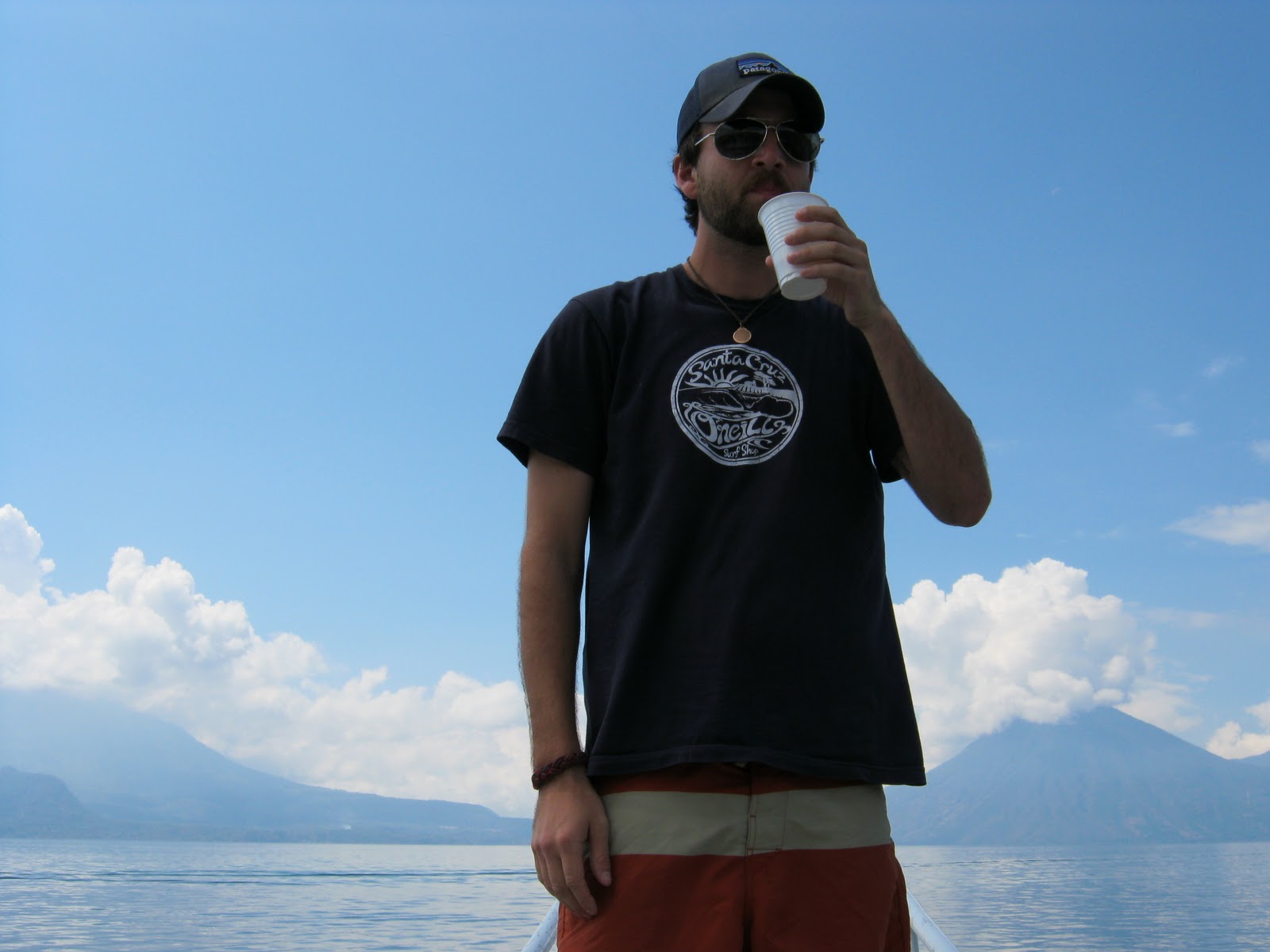
From Antigua, we joined some of our Habitat friends and took a shuttle up to Panajachel, which is a town I wasn’t that impressed with on the coast of Lake Atitlan. When driving down into Pana from the surrounding mountains, some clouds clouded our view, but driving down into clouds was certainly a neat feeling. We spent a night in Pana, had our fair share of fun, embarked on a boat in the morning to spend a day on the lake with about 25 of our closest friend, and enjoyed that as well.
After the double decker boat fun, we docked in San Pedro, one of the cooler towns we’ve been in. Situated on the lake with a fairly diverse group of habitants and visitors, the town reminded me a lot of the jewel of California—Santa Cruz. Laid back, good food, good drinks, good music, and slightly seedy, we had a pretty good time seeing some live music (Dr. Sativo again) and enjoying the nightlife and the hotel’s hammocks on Sunday. Along with Dr. Sativo, we saw a group from Guatemala City called Bacteria Sound System that absolutely blew the house down. While I’m not fluent in Spanish, I met some dready English speakers from the capital that were willing to explain much of the message to me. Essentially it was pretty neat to experience some really really really good hip hop that transcends much of the popular shit coming out of the States these days. Essentially using hip hop not only as a very real art form but also a method of motivating the social conciousness of the country in a direction other than violence and the drug war, was a really neat thing to be apart of. As with any group, when you are in the crowd and they are bringing an intense energy that takes over the people, it’s an amazing feeling. But after all that, we feelt the most exhausted that we have been in weeks, and we hopped on a chicken bus to embarked on the three hour bus ride back to Xela.
Bacteria Sound System
When we decided to return to Xela, I didn’t want to make the same mistake that I did last time I was here and do very little with my time, so I decided to participate in some Spanish language classes and a home-stay with a local Guatemalan family. The school is only a few houses down from Jamil’s apartment and my family is only half a block away, so it’s nice to be in the same neighborhood but to experience it in a slightly different way.
My host-mother Doña Miriam, is a fantastically patient woman who lives with her son, her daughter, her son-in-law and four-year-old granddaughter (who is an absolute delight to have around). There are also two other renters in the house—a local woman and a twenty-something Aussie guy who also studies at the school with me. Thankfully Doña Miriam is a wonderful cook, and I’m pretty lucky to be getting not only a bed (as I was sleeping on the floor at Jamil’s) and a fluent person to converse with, but also three warm, home cooked meals—something that Jamil didn’t include in our housing contract...for some reason.
The House Courtyard
I’ll be going to school everyday this week from 8am to 1pm and being back in school is certainly a change of pace in my life. Old nightmares of being up late studying have been haunting my sleeps, but my teacher, Mario, is not one to put pressure on his students. A native Guatemalan, Mario has lived all over Central America doing various jobs other than teach Spanish. The one on one style of teaching certainly beats out all my past struggles of learning a different language, and certainly being in a Spanish speaking country, forcing myself to learn the language helps with my retention. Fully knowing the benefits of learning the language has helped my drive, and it is pretty remarkable how much more I feel I have learned and retained (especially since Mario and I talked for 30 minutes today about bears—all in Spanish). Also being an older man (in contrast to the rest of the twenty-something teachers), Mario is able to provide a lot of insight into the changes and challenges of living in Guatemala over the years. Today we talked quite a bit about his ten years of living in Guatemala during their 36 year civil war (a war that only ended in 1996) and the decisions his family made during the time to move out of the country to places like Mexico and southern Texas. Enough words can’t be said about the value of giving an ear in a place like Guatemala.
Sadly Harvey leaves the country tomorrow, but I still am planning on staying. I have class through Monday and am planning on catching a shuttle up to Chiapas, Mexico to visit San Cristobol de las Casas. I’m pretty excited to not only make the trip that the original three of us planned on taking so early in our travels but had to delay, but also being able to see how my Spanish lessons hold up in the real world. Depending on if I have time, I’ve been throwing out the idea of taking more lessons (whether it’s language, cooking, dancing, or music) while in Chiapas. I really have a vague idea of what to expect on my travels up north, but the region has such an amazingly rich story, I’m getting really excited to experience the people, landscape and culture.
It's crazy to think that just over a month ago I never spoke a word to this guy. We've been through so many good times down here... Going to miss having him around. This is a great video of him passing some time at Earth Lodge. He's gotten amazing since I took this.
Sometimes it’s easy to get wrapped up in emotions down here, and while I didn’t really care to talk about politics in this blog, I think it’s one of those things that’s inevitable while in a developing country—let alone a Latin American one. Other than that last post, I’ll probably not get too political anymore. So with that out of the way…
The tough life
Harvey and I currently find ourselves literally laying in hammocks, feeling a cool breeze float over the hot black sands, and listening to some pretty relaxing music here in Monterrico. Our hostel, Johnny’s Place, is pretty much the ideal tropical bungalow: tree trunk supports, palm roofs, stiff drinks, and an attitude that says, "Hey stay for a few days because...why not?"
I had come to the beach with the intention of finding some waves that I could surf, but Monterrico is not the place for such things. With no real identifiable point or reef break, the waves are unpredictable at best and deadly at worst. The tubes are fast growing—and they grow very, very big—and fast crashing, and when they crash they land right on the sand. If you find yourself getting caught in the underside of a building wave, I’ve found it’s best to try to not resist it’s power and just try to not land on your head (trust me from personal experience—not fun). What is the most spectacular phenomenon about the waves here in Monterrico is the undertow. The back suction from a receding wave is absolutely unbelievable, and we’ve seen our fair share of unsuspecting people get trapped in the mess of a break here.
With all that aside, there are certainly better times to be trying the ocean than others. Yesterday, Harvey and I spent a good two hours boogie boarding, body surfing and getting our asses handed to us by the force of the Pacific. Being in the ocean is always an insanely humbling experience, and the breaks of Monterrico have certain proven to be the pinnacle of that for me. Hanging out in the NorCal waters has never really been too big of a struggle (local territorialism aside), so experiencing the real force of the ocean has been quite the learning experience.
Another thing that has been a learning experience has been the dogs down here in Guatemala. Everywhere you go in this country you see packs and packs of stray dogs mingling all over the place. Most of the time you will see the dogs in the cities and their only concern in the world is finding any scrap of food that they can. Since Xela didn’t have the most efficient trash pickup service I have ever seen, there would often be large plastic bags of trash left around businesses late at night. It was not an uncommon thing to see 20 if not 30 dogs surrounding a few bags, tearing them apart and fighting over food scraps. When you did see it, it was absolutely amazing to watch—from a distance of course.
Most of the dogs we’ve encountered here have been really, really sweet, beautiful dogs. Since it seems that Guatemala has gotten the memo on the benefits of spaying and neutering their animals, the mutt mixes in this country have made for some beautiful animals. While I would love to be able to take one of these dogs home, for some reason I don’t think my parents or the National Park Service would appreciate my humanitarianism. But overall the dogs in Guatemala haven’t really been any cause for concern, until we got to Monterrico.
When I think about all the travel stories I have heard over the years, there is one that takes the cake for being the absolute greatest. I hope she forgives me if I tell the story wrong, but when my friend Sarah and her friend Colleen were backpacking throughout Southeast Asia, they found themselves being chased by a seemingly rabid Cambodian mutt. Wanting to avoid the consequences of being attacked by a wild dog overseas, they tried to hightail it away from the dog. For Sarah, that choice ended up being a wise one, but for her friend Colleen—who cartoonishly got bit on the butt by the mutt—the end result was not so glorious.
So with this story in mind, I have been very, very careful about my interactions with dogs in this country, but like I mentioned before, I haven’t had any problems. But the other evening, Harvey and I decided to take a romantic stroll with each other down the beach to explore the area and watch the sun set over the Pacific. While walking down, we noticed a little crab scurrying about a conch shell, and I stopped to take a picture. A pack of four dogs mosed on up to the conch shell and started sniffing around it, trying to make something of it. Wanting nothing to do with the dogs, Harvey and I kept walking, talking in a loving voice to the dogs as we passed them (something that we always do). But within 15 seconds of us walking away, we found ourselves getting surrounded by the four dogs, as they barked loudly, showed their teeth and snapped their jaws at us. It was at this moment that I had wished I read that “Worst Case Scenario” book that I always see for 50% off at Borders. Instinctively I decided to react to these dogs as I would if I saw a mountain lion, so I backed away slowly hoping that I would show to them that they had the dominance in this situation. That didn’t work. I looked behind me and saw that Harvey was actually getting away from the situation successfully by walking very fast into the water and allowing the dogs to focus all their attention on me. So while backing away didn’t work, I decided to take the black bear approach, so I lunged at the dogs and started screaming and yelling at them. While they were initially shocked at my reaction, I only pissed them off more. I tried looking around for a large stick so I could fight my way out of the situation, but there wasn’t one to be found. With my luck looking very dire at that moment, another pack of dogs came out of nowhere with their snouts gnarled, barking very loudly at my attackers. This new pack swooped in and diverted the attention from me on to them and the two packs began to fight, as I was able to make a quick get away. Needless to say, we don’t go exploring on the beach anymore.
We’re spending our last day in Monterrico with some newly made expat friends, taking dips in the pool and staying out of the sun, as the two of us have some of the worst sunburns we’ve ever gotten. Now I can hear all of you saying to the computer, “Brien you need to put on sunscreen,” and in response let me tell you that I reapplied three times yesterday but it didn’t matter.
We are in the process of deciding whether we want to chase the surf South to some nicer beaches in El Salvador or head up to Honduras for a few days. We’re getting pretty excited for a large boat party this upcoming week in one of the most beautiful lakes in Guatemala, so the future is looking bright. Oh, and Harvey’s birthday is on Thursday. Good times ahead, I hope everyone is enjoying life back home.
Also, kudos to everyone in Madison standing in solidarity, as it is very neat to see videos and photos from the protests in the Capitol Square.
After a long struggle with multiple days of good parties, a little bit of sickness, and quite the journey on a series of chicken buses, the back of a pickup truck, and a boat trip through the thick mangroves of the Pacific Coast of Guatemala, Harvey and I have survived the Xela experience and find ourselves in the serene and beautiful beachtown of Monterrico.
Our time is Xela was absolutely fantastic to say the least. Spending two weeks getting to know not only the city but many of the people was an invaluable experience, and Jamil and his roommates hospitality can never be overstated. My time is Xela was mainly spent navigating the markets, looking all over town for a guitar store (didn’t find one), befriending both gringos and chapins alike, jumping in the deepend of street food, and drinking what is quite possibly the greatest booze ever created: Quetzalteca.
Quetzalteca is an aguardiente, which is similar to rum in the fact that it is a derivative of sugar cane, but very different in regards to the fact that a liter of it costs about $3.50. Now back home when you think of any booze that would cost $3.50—let alone an entire liter of it—you probably would make a face of disgust and vow to never, ever try that cheap, harmful liquor. It is with this sentiment that Quetzalteca will blow your mind, because this liquor not only mixes PERFECTLY with just about any mixer but I have yet to have a hangover from drinking only Quetzalteca. In fact, I feel great the next day. I’m not sure if this is a good thing.
So after a few nights of making fools out of ourselves trying to learn how to dance salsa, we were able to catch a few nights of live music. While the dance clubs are a lot of fun in Guatemala, this country is obsessed with maybe five songs and it seems as if those are the only songs that get played. So some live, original music was a nice relief from all of that. We were able to catch one salsa band that absolutely set the dance floor on fire (for everyone else—not our gringo asses), and watching seasoned salsa dancers at their best is one of the coolest things to experience. Moving across the floor with movements that resemble water, the men spin the women around, contorting their bodies in a way that defines not only the beat of the song but oftentimes gravity itself. But being gringos that haven’t had enough practice to tear it up on the salsa floor just yet, we needed to find some enjoyable music more our speed.
This past Saturday seemingly all of the youth in Xela packed themselves in a small club to witness the energy of latin reggae artist Dr. Sativo. Originally from Guatemala, Dr. Sativo made a name for himself not only playing with his former band, Barrio Candela, on the streets of Barcelona, but also releasing an ode to his homeland (a song aptly named “Guatemala”), which received quite a bit of praise in these parts of the world. Dr. Sativo’s nine piece band drew up a new definition for the word party, as seemingly every Spanish speaker in the room knew every word to every one of his songs. Sharing one of our last evenings in such a spectacular city with just about all our friends that we’ve made in this country was beyond blissful, and it will defiantly go down as one of the top highlights in this country.
Then we woke up the next day.
A little beaten and battered, we all went out to breakfast to enjoy some greasy hangover food and hot coffee. Not feeling the best (due to a bit of a sickness that had been bothering me for a few days), I took a heavy dosage of vitamins and Dayquil to help battle my illness.
Due to the sheer amount of pollution in the Guatemalan cities, I haven’t really felt close to 100% since being in the country. While it seems that a bit of my asthma from my youth has made a slight comeback, really I can’t imagine anyone (asthma or not) not having a difficult time breathing with so much diesel exhaust in the air.
While my self medication allowed me to make a quick recovery in under 24 hours, Adam, did not fair so well. In addition to feeling a bit affected by the pollution, Adam also unfortunately thinks he ate a bad piece of meat at a BBQ we had prior to the Dr. Sativo concert on Saturday. His stomach didn’t fair too well, and in an effort to combat his sickness with as much haste as possible, we visited the Xela Red Cross for a little checkup.
A full IV, antibiotics, and two and a half hours later we were able to leave the Red Cross, but his sickness led to the three of us to make a decision to postpone Chiapas, Mexico and head to the beach. However, the only problem with heading to the beach is the fact that you have to take the stomach-turning chicken buses roughly seven hours to get there.
We made the decision to head that way on Tuesday morning, and after boarding a chicken bus early, it did not take to long for Adam to realize he probably wouldn’t make the journey in one piece.
To be honest, there are a lot of things in Guatemala that aren’t for everyone—and you learn that very quickly down here. Being crammed into a chicken bus with sweating Guatemalans literally sitting on your lap while they slurp off every bit of meat off the chicken that they just bought through the bus window, is not something I would recommend to too many people. Hell even sitting on a chicken bus without it being crammed is not for too many people, especially if you get tense when driving. Some of the street food, while delicious, may look sketchy at best, and without being too graphic lets just say that just about everyone battles with their stomach at some point while visiting. However, I’ve found that pushing through these things are what makes the struggles worth it.
It’s very easy for someone to come to Latin America and go to the places that make life easy and seem like you are in the States. But while you can do these things very, very easily down here, I always wonder what is the point? What can you learn about the people, the culture, the way of life of the people in Latin America if you stay within your comfort zone? What do you learn from your fellow countrymen/women and global citizens traveling abroad when you sacrifice everything for adventure? Hell, what do you learn about yourself?
This book: Don't read it while
in Latin America.
I feel a lot of people in America are quick to say that we live in the greatest country in the world, but when only 30% of the population has a passport and only HALF of that travel to a place other than Canada or Mexico, you have to ask: what the hell do we know? In the context of traveling around America and seeing a lot of the things that I’ve seen, I’ve come to realize how special my upbringing has been and how lucky I am to have the family that I have. You can read about poverty in the developing world in as many books that you can until your head explodes, but it isn’t until you see a child gathering water from a hose that is dripping out onto a dirt road covered in sewage and trash can you really put a face on something like that. And it’s not until you recognize these faces and the families that these faces go to and the struggles these families push through, do you really understand how stupid arguments against “illegal” immigrants really are. Who the hell are we to put ourselves on a pedestal of greatness when the only reason we are who we are is because we have stepped on numerous people—hell an entire continent—in order to get there. If anything we owe these people a solid look in the eye to realize how lucky we are, and taking the time to do that isn’t for everyone. Taking the time to realize our true impact on the world isn’t for everyone.
There aren’t enough words in my vocabulary to show the amount of respect I have for those down here, on the ground making an impact. I have the deepest, deepest respect for those I have befriended not only in Habitat and the Peace Corps down here, but those who are traveling, volunteering and writing back home about these places (not only in Guatemala but throughout Latin America—especially anyone reading this in Haiti).
My biggest regret of this trip is how little I have felt I have done. There are a million and a half excuses, but none of them hold up to the truth that I have just been lazy with my time. There is still time left, and I hope I am able to give back more than just a few quetzales, a “thank you”, a smile, and my story. I hope to learn this language in the future, because without it you can only get a glimpse of the life down here. Also, for the record, Guatemala isn’t just a life of struggles and have-nots, but also a place of culture vibrancy, smiles, and an unbelievable willingness to help outsiders—a willingness that I really have not felt in too many places through my travels in the United States (unless, of course, money was involved).
Going through the struggles down here, while living through your own personal hell of a sickness is not something I would wish upon anyone. Due to his sickness (and after a few days he looked like he lost quite a bit of weight), Adam made the decision that it was his time to go, and I’ll defiantly miss having him around. I had more than my fair share of apprehensions about traveling down here, and I almost didn’t even come. But it was because of his persistence and my faith in his judgment that I made it down to this country, and for these experiences that I have had and for these friends I have met, I cannot thank him enough.
Adam leaving has certainly started a new chapter in this adventure for us, and while we will miss him, Harvey and I plan to push forward. When talking to Adam, he stated that being abroad for an extended period of time really makes you realize where your boundaries are and you really learn something about yourself. For me, I’ve learned that this experience is only the beginning, and I thrive in these environments. I’m thriving in the unknown. Thriving abroad.
A side note: I want to mention that technology is pretty cool. For $20 I purchased a little mobil modem for my computer that works all over Guatemala (even on black sand beaches). Why would I do something like this is such a pristine area? Well, Radiohead has a new album out, and I'll be damned if I can't hear it while the sun sets over the Pacific Ocean this evening.
The surf is breaking, and the ocean is calling my name. I miss everyone back home, and I hope they know it. I’ll try to catch a wave for all of you down here in the hot Guatemalan sun.
Be sure to read ¡A Huevos!: Part One, which was posted earlier today!
I previously mentioned that I did very little research before traveling down to Guatemala. I thought that just traveling down here and figuring things out as I went would be the best method for me, as I don’t really care all that much for a whole lot of structure during my leisure time. So in many ways I came down here with some preconceived ideas as to what I would be experiencing. Since Guatemala is so close to Mexico, I figured that the food would be very similar to Mexican, and I would be a happy camper eating. This proved to be a correct—I am a happy camper. Another thing that I assumed was that since Guatemala was so close to Mexico, Guatemala would also be hot. It is on this notion that I wish I had done a little more research.
Mercado La Democracia
Don’t get me wrong; the days are pretty hot around here. With temperatures reaching into the 80s, walking around town during the day has been a rather pleasant escape from the bitter winter of the Midwest. Even at night when temperatures may drop down to the 50s, I am quite comfortable walking around in the various button-up shirts that I brought. But there was one consideration that I did not think of: temperatures on the volcanoes.
When looking at photos of the volcanoes in Central America there is one thing you never see: snow. Since you don’t see snow and the photos look so green, I had assumed that the temperatures probably weren’t so bad on the rocks, and as a result of this, I didn’t bring too many warm clothes. Also because I didn’t really care to carry around the weight of a sleeping bag throughout Central America, I also failed to bring one of those. Now some of my warm gear really isn’t that heavy (synthetic long sleeve shirts, Under Armor, etc), but for some reason I wanted to forgo that weight.
Well that was pretty dumb.
While on Acatenango, we quickly found out how cold it gets at 13,000 ft during the night. The cold was absolutely brutal, and it was only increased with the ferocious wind that tore deep into our souls. Thankfully, we decided to climb Acatenango with a guide, and OX provided us with whatever warm materials we needed. But when you hike with a guide, that sort of thing costs money—something we don’t really care to spend on activities we are perfectly capable of doing on our own.
When we arrived in Xela, we made pretty quick plans to make our way North and spend a day and a half climbing the 13,845-foot Vulcán Tajumulco, also known as the highest point in Central America. Back in Antigua, we met a group of Peace Corps volunteers who were toying with the idea of climbing the volcano, and as it worked out, set the date for their climb on the same day as us. In addition to having climbing buddies, we also resolved to save ourselves 400Q or so by doing the climb on our own—a choice that would mean that I was S.O.L. when it came to a sleeping bag and warm clothes. Thankfully, Xela has a vibrant market and thrift store scene.
So far we have discovered three open-air markets within walking distance of Jamil’s apartment. Each market has a large variety of vendors selling everything from fruit, veggies, and grains to clothes, shampoo and pirated DVDs. The market closest to us (Mercado Las Flores)only has vendors during the morning hours and pretty much only sells food. As someone who has enjoyed being addicted to the Madison Farmers Market, walking around the various ethnic markets in California and spending a good portion of his free time in the Chicago area walking around the various big box grocery stores for entertainment, the Xela markets are an absolute godsend.
Freshly squeezed juice in a bag
Walking around Mercado Las Flores is a feast for the senses. The sounds of offers and bargaining fill the air, complementing the bright colors of not only the fruit and vegetables but also the garments worn by the Mayan vendors. In an attempt to get you to buy their produce, many vendors offer out free samples of their product, but for me, an avocado is an avocado and I can hardly taste the differences. While some of the smells are pleasant in certain areas of the markets (ie: where they’re squeezing oranges for freshly bagged orange juice), the market isn’t a place where you should expect to smell anything too pleasant. The main reason for this is that in addition to fruit and vegetables, there are also meat vendors at the market.
As someone who was a vegetarian for a good deal of time, one would think that the sight of freshly butchered and bloody carcasses hanging from hooks, dripping the familiar reddish color of cow juices on to the tiled stands would be disturbing, but I’ve had the exact opposite reaction to the carnicerías. In fact I actually really enjoy the fact that when I go to the market here in Guatemala, I have the opportunity to not only see but also buy animal flesh that I can tell was killed very very recently.
Back in the States, I think we’ve gotten too complacent with the idea that our meat is delivered to us shrink wrapped and stamped with government approval that we’ve become significantly disconnected from the reality of meat: the flesh was once an animal. Guatemalans do very little to hide that fact, and in some areas I’ve seen whole chickens for sale with a few feathers still on the meat—a rather comforting freshness.
I’ve also noticed that Guatemalans waste very little of the animals that they have butchered. Laid out on the tiled booths is just about every part of the animal, and each part has a price. Want some cow liver soaking in blood? 20Q. How about chicken feet? I hear it’s a great snack. Five for 15Q. There are so many parts of animals on display for sale in the meat sections of the markets that I have never seen many of them before. Even walking on the streets around the markets, you might be able to spot a cow leg or hip lying on the cobblestone, surrounded by hungry stray dogs.
I have found that its not only the sensory overload that make the markets so enjoyable for me, but also the culture surrounding the bargaining for prices and the ability to get so much for so little. After spending nearly $7 to $10 a day on meals in Antigua, being able to go to the market and realize that that same amount of money can buy us food for nearly two days is unreal. It also makes you think about how overpriced a lot of food is back in the United States, but then again when you are paying for apples to be shipped from New Zealand it ends up making sense.
Surrounding Marcado Las Flores is a wide variety of thrift stores. I have heard that many Guatemalans look down upon the thrift stores, thinking that buying used clothes is a dirty practice (I’ve definitely gotten this vibe in the United States), but that didn’t really bother me, as I would rather wear someone else’s clothes than freeze to death at 13,000 feet. The three of us were actually really surprised at the quality of the clothing in the thrift stores down here, as Adam picked up a fairly mint Woolrich flannel, Harvey a thick, well crafted hoodie, and I got a Sierra Designs fleece that was just about as good as new. While the thrift stores helped fill out some of the missing pieces to our mountaineering gear, I couldn’t find one that was selling any down sleeping bags or even gloves. So headed to Mercado La Democracia, the largest market in the city.
Encompassing an area of roughly five squared city blocks, Mercado La Democracia is where you go when you need...well…anything really. The market is not only located on the sidewalk and spilling out into the crowded city streets, but it also bleeds into an indoor labyrinth of vendors in a building that takes up an entire block.
We quickly found wool mittens that would work well in the dipping temperatures of the mountain, but I had trouble finding a sleeping bag. Unwilling to travel up the mountain without any sort of warmth, I ended up haggling a blanket vendor for a Mayan wool blanket down from 90Q to 65Q. Not a bad deal. Not wanting to have to carry the entire blanket up the mountain with me (it was the size of a king-sized bed), I used my knife to cut it in half and then quarter one of the halves, so I could add an additional wrap to my feet. With packs loaded, we awoke at 5am, made a quick breakfast and headed to the Xela terminal.
I had communicated with our Peace Corps friends in the days prior to our departure about meeting them at a certain time at the volcano trailhead. Without a cell phone (we lost ours somewhere…oh well), we knew that meeting everyone at the exact time without doing some waiting might prove to be difficult. To add to that, the three of us really have little idea about how long it would take to get from Xela to the city of San Marcos and then to the trailhead. Jamil estimated that it would take somewhere between 45 minutes and an hour and a half to get to San Marcos, so we figured we would try to get there early and wait for the others if needed. In one of the most amazing events I have ever witnessed, all nine members of our party (coming from 4 different regions in the country) met at the bus terminal in San Marcos almost literally at the exact same time. It’s amazing what you don’t need technology for sometimes.
Taking around five hours, our group flew up the mountain, hiking alongside what seemed like nearly every trekking company in Xela along the way. Some of the trekking companies had different ideas about the ethics of the climb, and one in particular drove their clients a third of the way up the mountain on a dirt road and proceeded to cut down a few trees when they got to camp. Believing in the principles of Leave No Trace (in short take only pictures and leave only footprints), the three of us were pretty appalled by the antics of the guides, while the clients were pretty oblivious to any wrongdoing.
Due to a combination of tiredness and the threat of cloud cover, the majority of our group opted to wait to push on for the final 45 minutes that it would take to summit the mountain in exchange for some rest and attempt the final climb for sunrise. Adam, Harvey and I thought back to our experience on Acatenago, where a bad night of sleep prohibited us from doing nearly anything the next morning, and took the more impatient approach of trying to summit before sundown.
After dropping our excess weight and gear in camp, we gathered our essentials (pretty much just water), and made the final push. The path to the summit proved to be very steep with some rock exposure that boarded on the easy end of Class 4, but there wasn’t anything that we couldn’t handle. Having forgot a carabineer at camp, I was forced to do most of the final push with one hand, as I didn’t have a place to clip my water bottle—sometimes taking a little bit of time to plan is good kids.
As we reached the lip of the volcanic crater, dense clouds started moving in and blocking our view. From the top, the view had the potential to be amazing, but because of cloud cover we would only get a few glimpses of the view during short cloud breaks. But the glimpses we were able to see were unreal. A sea of rolling fog gave way to tremendous towers of clouds that seemed to be thousands of feet high. The sun broke through every few minutes and exposed the depth of the crater, whose edge we were standing on. Being up there was exhilarating and terrifying at the same time, and as more dense clouds moved in, we decided to descend from the mountain.
Gassed and hungry, we scarfed down our dinner and shared stories around the campfire before retiring in our borrowed tent for the night. The morning bustle of the other hikers awaking in the still black predawn inspired me to try to make summit again for the sunrise, but I only made it half way up the final push before the altitude and exhaustion told me to stop. But I did get in a few pictures.
Sunrise with Agua, Acatenango and Fuego on the horizon
Summit!
We don't have the best of luck
with tents...
Machete S'mores
We’re going to be spending a few more days in Xela…through the weekend is the plan. We had plans to do a big trip from Chiapas, Mexico to the Mayan ruins of Tikal and over to the beaches of Belize, but we have changed our itinerary to spend that week and a half only in Chiapas in order to get a real feeling for the region. Having had a serious interest in the region since my sophomore year of college (through classes, my volunteering at a leftist bookstore and want to go on the Just Coffee Coop delegation to the region), I am very excited to experience Chiapas. Without a doubt it is the part of this trip that the three of us are most excited for. Hopefully, the next update on this blog wont take so long.
Most days waking up it’s nearly impossible to believe this is the life I am living. I haven’t been the best at updating this blog because I’ve had a bit of writer’s block and have really grown comfortable in my routine here in Xela. So much of what we’ve been doing here feels not like a vacation, but as if we are just living our lives in our own form of paradise. We aren’t running around visiting the tourist hotspots like so many other travelers, and as a result of that, I feel as though sharing my life here on the internet would only bore those that are reading this.
But alas, I will do my best to sum up this past week in this amazing city of Quetzaltenango.
After spending too much time in Antigua, Nosotros, Los Trés Gringos left the tourist trap for our natural environment—the Western Highlands of Guatemala. Our journey began with the three of us walking through the open air market of Antigua toward the bus terminal with our large packs on, towering over what seems to be an entire subcontinent of people, and surely sticking out like a trio of confused, sore thumbs. It didn’t take long for us to be approached by various men asking us where we wanted to go.
The Gringo Trail is pretty well worn here in Guatemala, and there have been numerous times that we’ve felt that those around us knew exactly where we were going—even if we didn’t.
After being directed to one of the infamous chicken buses to Quetzaltenango (or Xela, it’s Mayan name), a man (the ayudante) on the roof of the bus climbed down, effortlessly grabbed our heavy packs and swung them on the luggage carriage bolted to the top of the decommissioned school bus.
The chicken buses are one of my absolute favorite things about life here in Guatemala. Walking through the bus terminal in any city here is like taking a step into chaos. Everywhere you look there are numerous people trying to direct you to a bus or sell you something to eat, and if you are not careful, you can easily get run over by a bus, micro (shuttle van) or taxi trying to race out of the terminal (aka, glorified parking lot).
As I mentioned in an earlier post, the chicken buses here in Guatemala are decommissioned school buses from the United States that have hit the 150,000-mile mark, are shipped down to Central America and go through a process of Frankensteination that transform them from the quaint, recognizable symbols of an American childhood to psychedelic, supercharged, bass-thumping modes of mass transit. While I haven’t spent a lifetime researching the “party buses” that we have in the States, I firmly believe not a single one can hold a candle to the buses down here.
Antigua Terminal
When the buses get down here, the original engine is ripped out of the body of the bus and refitted with an engine that has been strewn together with the ability to allow the bus to travel as many miles in a day down here in Guatemala as it did in an entire week back in the States. Above the windshield on the buses are the painted destinations to where the bus will be traveling, and because there is a large amount of illiterate individuals here in Guatemala, each route has a specific color scheme that accompanies the text. In addition to a lot (and I mean a lot) of chrome, those same colors completely cover the familiar yellow on the exterior of the buses in a large array of patterns.
Even though there are typically three adults to a seat (with many more packed in and standing on the bus,), when walking on the buses the first thing you notice is not how crowded it is, but the deafeningly loud music. Blasting anything from the bass heavy rhythms of reggaeton to Spanish-language covers of 80’s pop songs, many of the sound systems that we’ve experienced on these janky buses are some of the best I have heard in any automotive. Hannah, a friend down here, has a theory that you can tell how the ride on a bus is going to be based on the music that is blasting from its speakers. If the music is mellow, she claims, you’re in for a relatively relaxing ride, but if the music pulsates with the sounds of the sweaty clubs, then you better hold on for your life.
And finding a firm hold is a skill that is never underestimated.
While coming back from a backpacking trip earlier this week, our group had trouble finding seats on the bus, so we were forced to stand, crushed against each other directly behind the cab of the bus. While we were barreling down the curvy mountain highway, whipping around every turn, holding on to metal bars fixated on the ceiling of the bus for dear life, and trying not to fall into each other, Harvey turned to me and poked my shoulder.
“Hey, did you see the speedometer?” he asked.
“No, why?”
“Because there isn’t one.”
Speedometers don’t exist on chicken buses, because speed limits don’t exist in Guatemala. The drivers use their best judgment in gauging how fast they should take each turn, and most of them don’t have the same conscientious judgment that we are accustomed to in the States.
What is most impressive about these buses is that while they are barreling down the mountain roads at 70 mph, the ayudante is not only calling out the various stops, but also climbing on the exterior of the bus like a monkey, pulling luggage off the roof and climbing back into the open door of the bus without even breaking a sweat.
Often the drivers are in such a hurry that they feel there is little time to come to a complete stop to let people on an off the bus. As a result, it is not uncommon to see people literally running and jumping on to the bus, while the poor ayudante grabs their bags or baskets and swings them on the roof.
Xela tagging
After a four-hour ride that felt nothing short of four years, we finally arrived in Xela, and my first impressions of the city were that of a joyous shock. Having done zero research before coming to Guatemala, I had assumed that Antigua (a city of which I had actually heard) would be the larger of the two, but I was way off. Being the second most populous city in Guatemala with 160,000 people, Xela bustles with the vibrancy of any large city, and unlike Antigua, gringos are—thankfully—few and far between.
I was pleasantly surprised to have a rich and diverse Guatemalan culture thrusted in my face, and despite being in a large, smoggy, metropolitan area, the micro culture shock that I experienced was a breath of fresh air. As when experiencing any large city for the first time, Xela’s winding streets, lock of English speaker, and dense, fast moving traffic is very intimidating at first, but has been a pleasant challenge to try to fully know and understand. I think each of us have really taken to the chaotic, loud nature of this city.
Upon arriving in Xela’s Parque Central, we were greeted by a beaming Jamil and friends and treated to nearly a dozen litros of the locally brewed cerveza Cabro and one of the best burgers I have ever eaten. After dropping off our bags in Jamil’s huge apartment, we headed to his favorite hole-in-the-wall bar, where we were told that the nightlife would be a little different in here than in Antigua.
In an effort to try and enforce a curfew in Antigua, the city pretty much shuts down at 11 pm, as the bars lock their doors and refuse to allow any more entrance. Being from cities whose last call is around 4 am, the three of us were really taken aback by this early schedule, because if you didn’t know where you were going for the night by 10pm, you probably were not going to be able to make it out to any place that was hopping.
Parque Central
Xela on the other hand does not operate like this. After going to a party at the bar by Jamil’s place, we went to an after party at the club down the street. After the after party at the club, we found ourselves at an after after party at another bar before stumbling home to the after after after party in the apartment, where we collapsed on the couches and floor in exhaust. Xela has been a nice return to balance in that regards.
But while each of us enjoy a few drinks of indistinguishable clear liquor mixed with apple juice now and then; we didn’t come down here to only party—that would be too American of us. Nestled at 8,000 feet in the Guatemalan mountains, Xela poses as a perfect jumping point for many of the larger volcanoes in the region. Since we have an informal goal to trying to climb the three highest volcanoes in Central America, we resolved to tackle the highest point in the subcontinent early in our trip: the 13,845-foot Vulcán Tajumulco.


 “When in Rome…” has been my motto down here in Central America, so after being invited to join the festivities, I sat in with the ceremony, chanted with the locals, tossed rice into the fire, and shared as much conversation as I could over one of the largest (and free) Indian meals I have ever had. I was given a large plate piled with rice, vegetable curry, samosas, and a chile relleno (this is Mexico after all), all topped off with a delicious mango lassi (did I mention the mangos are in harvest right now? YUM), and a couscous, brown sugar, and raisin dessert. The hostel also supposedly offers Yoga three times a day, but I didn’t see any sessions happening today—perhaps I will have better luck tomorrow. It’s funny that I came to Mexico only to experience Hindi culture, but it’s all in the adventure. I think I could get used to this life.